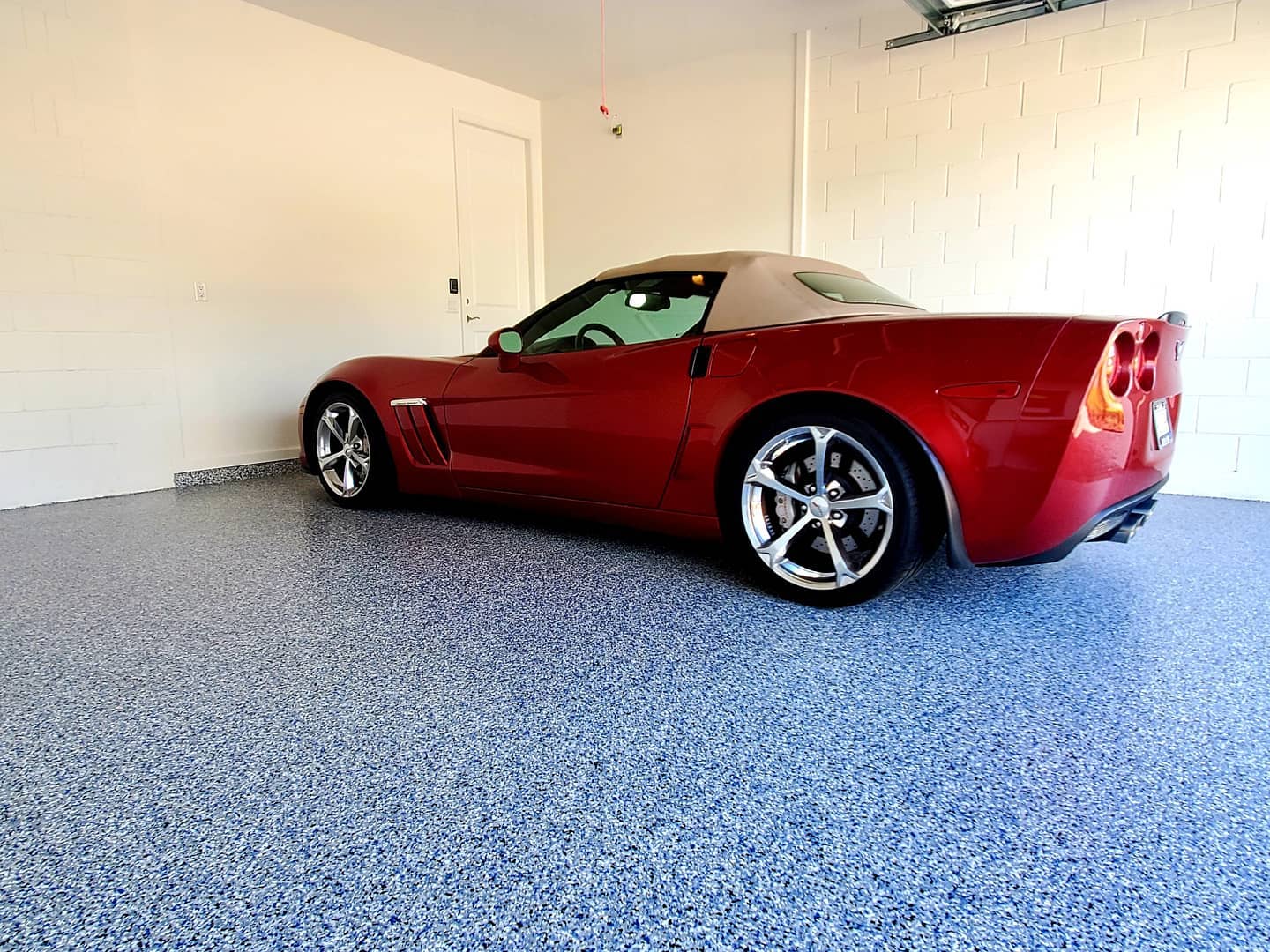
Storm Ready Floors: How Concrete Coatings Handle Florida's Humidity and Flooding
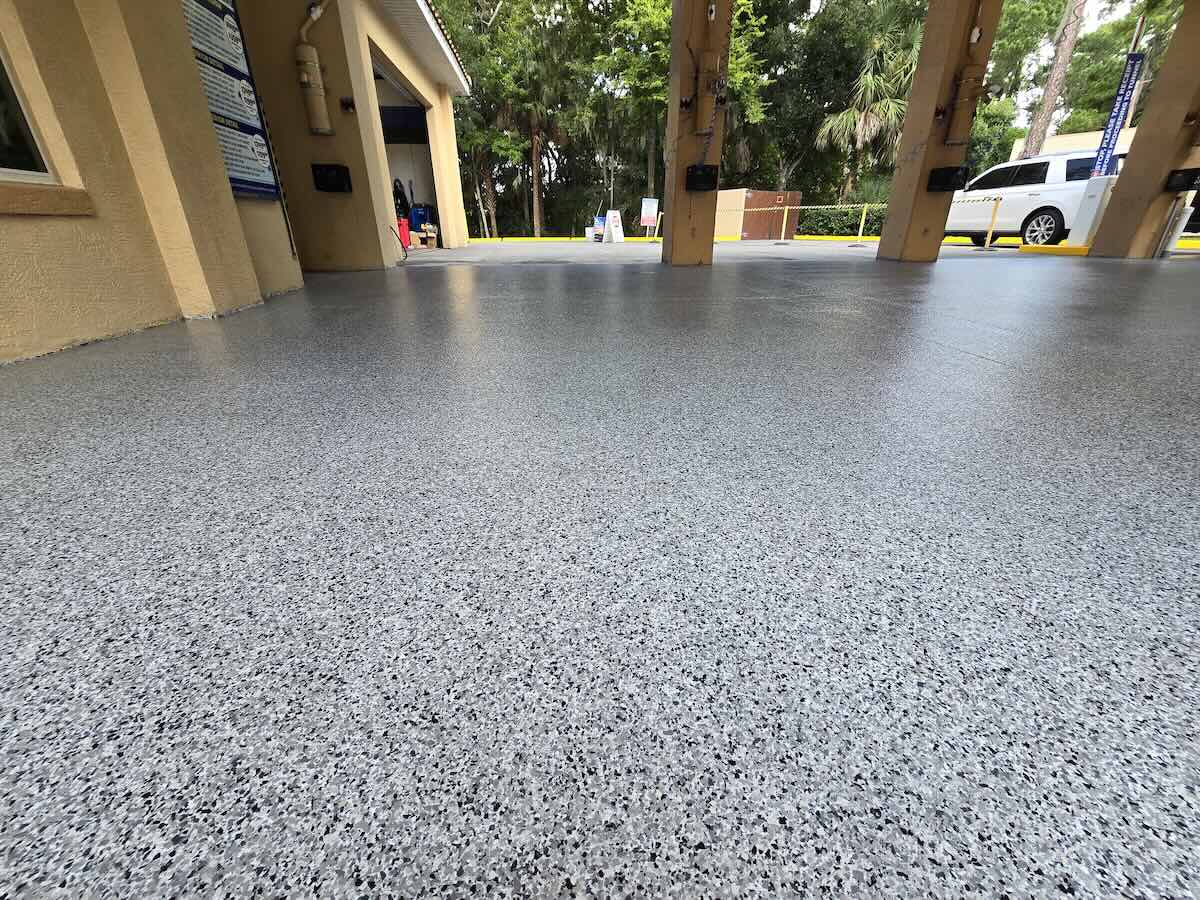
Hurricane season peaks in September, and the garage is usually where Florida homeowners find out what their house is really made of. It is the lowest finished space, it sits behind the largest opening in the building, and it is where water shows up first when a band of rain stalls over Volusia County for three hours.
Most of the questions we get this time of year come down to one thing: does a coated floor actually help, or is it just cosmetic? The honest answer is that it depends almost entirely on how the floor was prepped. A properly installed system will shrug off standing water and clean up in an afternoon. A poorly installed one will lift at the edges and trap the water underneath, which is worse than having no coating at all.
Here is what actually happens to concrete in Florida heat, humidity, and flooding, and what separates a floor that survives a storm from one that does not.
What Florida humidity does to a bare slab
Bare concrete is porous. It is not a sealed surface, it is a sponge with a hard face. In a climate that runs 70 to 90 percent relative humidity for months at a time, that sponge is never fully dry.
Three things follow from that. The slab stays cool enough that warm, wet air condenses on it, which is the sweating garage floor almost every Florida homeowner has seen in August. That surface moisture feeds mildew in the corners and under anything stored on the floor. And the constant wet and dry cycling pulls dissolved minerals up to the surface, which is the chalky white bloom called efflorescence.
None of that is a structural problem on its own. It is a livability problem. It is also the reason a bare slab never really comes clean.
Where the water goes when your garage floods
When water comes in under a garage door, it does not sit politely on top of the slab. It finds the control joints, the cold joints at the perimeter, and any crack wider than a credit card, and it soaks in.
On a bare slab that means the concrete absorbs whatever came in with the water: mud, lawn chemicals, oil that was already on the driveway, and in a coastal surge event, salt. You can pressure wash the surface, but the staining that shows up two weeks later is coming from inside the concrete, not off the top of it.
On a coated slab, the water has nowhere to go. It sits on the surface, and it leaves with a squeegee.
Moisture vapor is the real test, and it comes from below
This is the part that separates a system that lasts from one that fails in year two, and it has nothing to do with the storm itself.
Concrete slabs in Florida sit on damp ground. Water vapor moves up through the slab continuously, driven by the moisture difference between the soil and your garage. If the slab was poured without a vapor barrier underneath, which is common in older homes across Volusia and Flagler, that vapor keeps coming. Forever.
A coating that is applied without accounting for vapor drive gets pushed off the slab from underneath. It bubbles, then it delaminates in sheets. Homeowners usually blame the flood, but the flood just accelerated something that was already happening.
This is why we test rather than assume. Moisture testing on a slab before we coat it is not an upsell, it is the thing that decides which system goes down.
Polyaspartic and epoxy in a wet climate
Both are legitimate systems. They do different jobs, and in Florida we usually use both in the same floor.
Epoxy is the workhorse basecoat. It is thick, it bonds hard to a properly profiled slab, and it fills minor imperfections. Its weakness is UV: on its own, in a garage with a west-facing door that gets afternoon sun, an epoxy topcoat will amber over time.
Polyaspartic is the topcoat. It cures fast, it stays clear under UV, it resists hot tire pickup, and it handles chemicals and moisture better than epoxy at the surface. It is also what makes a one day install possible, which matters when you are trying to get a project finished before the next system spins up in the Atlantic.
For a Florida garage that may take on water, the combination that holds is a mechanically prepped slab, a moisture-appropriate primer, an epoxy or hybrid basecoat, broadcast flake or a solid color, and a polyaspartic topcoat.
The prep that decides whether your floor survives a flood
Coatings do not fail because of water. They fail because of what is between the coating and the concrete.
We diamond grind every slab. Grinding opens the pores of the concrete and creates a mechanical profile the coating can key into, which is a fundamentally different bond than a coating sitting on a smooth, sealed surface. Acid etching, which is what most DIY kits tell you to do, does not produce a reliable profile and does not remove an existing sealer.
We also chase and fill the cracks and control joints rather than coating over them, and we run the coating up the wall a few inches at the perimeter where the design calls for it. That detail matters in a flood. A floor with a sealed perimeter keeps water from wicking into the wall base and the drywall behind it.
The short version: a coating is only as strong as its grip on the slab, and its grip is decided in the first hour of the job.
Before the storm: a short garage checklist
None of this requires a contractor.
Get everything off the floor. Cardboard boxes wick water and hold it against the surface. Anything you care about goes on shelving or a rack, not the slab.
Clear the door track and the threshold. Sand, mulch, and yard debris build up at the bottom of the opening and create a dam that channels water sideways under the seal instead of away from it.
Check the bottom door seal. A garage door seal is a wear item. If it is cracked, flattened, or pulling away from the panel, it is not sealing, and a new one is an inexpensive fix compared to a wet garage.
Look at the grade outside the door. If the driveway apron slopes toward the garage instead of away from it, water is going to come in no matter what seal you have.
Move the chemicals up. Pool chlorine, fertilizer, and paint that get submerged turn a water problem into a contamination problem.
After the water goes down
On a coated floor the cleanup is straightforward, and it is worth doing quickly rather than letting the water evaporate.
Push the water out with a squeegee, rinse the surface with fresh water, especially if any of it was salt water or storm surge, then wash with a neutral pH cleaner and rinse again. Get air moving with a fan until the surface is fully dry. Do not use a wire brush or a stiff metal blade to scrape mud off. Let it soften with water instead.
Then look at the edges. If you see any lifting, bubbling, or a soft spot where the coating flexes underfoot, call us. Small delaminations are repairable. Large ones that get ignored spread.
What we would not do in a Florida garage
A few things we see go wrong, consistently.
DIY kits from a big box store are a one day project that lasts about a season here. They are thin, they rely on acid etching, and they include no moisture strategy at all.
Coating over an existing sealer, or over an old failed coating, without grinding it off. The new coating bonds to the old failure, and the whole assembly comes up together.
Installing during a rain event or in a garage that has not been dried out. Coatings cure to spec within a temperature and humidity window. Push past it and the chemistry does not finish, which shows up as a soft, tacky floor weeks later.
Skipping the topcoat to save money. The topcoat is the wear layer, the UV protection, and the chemical resistance. A basecoat with flake and no topcoat is an unfinished floor.
Do it once
A garage floor coating is not storm protection in the way that shutters and a rated door are. It will not stop water from coming in. What it does is make the water a nuisance instead of damage: no absorbed stains, no mildew in the pores, no chalky bloom afterward, and a surface you can push clean and be done with.
That is only true if the slab was tested, ground, and built with the right system for the conditions it lives in. That is the part we control, and it is the reason we do the prep the way we do.
Frequently asked questions
Will a garage floor coating stop water from getting into my garage?
Can a coated garage floor be damaged by standing water?
Does Florida humidity affect how a garage floor coating cures?
What is moisture vapor transmission and why does it matter?
My garage flooded and my floor is peeling at the edges. Can it be fixed?
Is polyaspartic better than epoxy for a Florida garage?
Get a real number for your garage
Free, in person, and firm. We do not price a floor without seeing the slab.
Keep reading
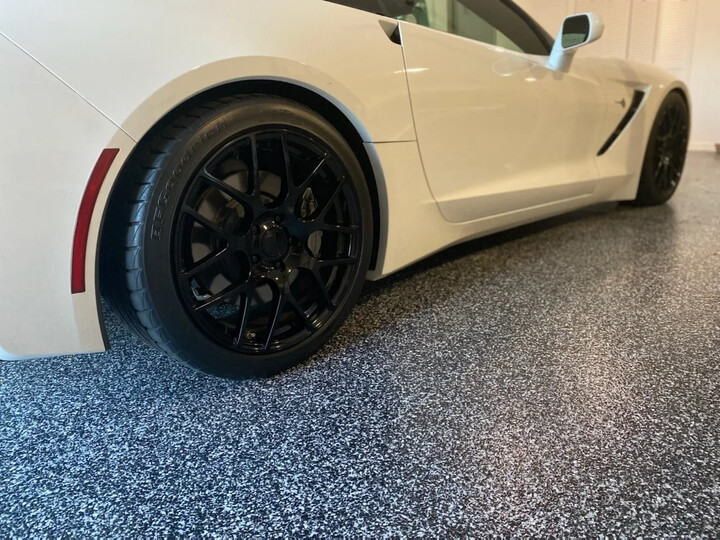 What a Garage Floor Coating Really Costs in Central Florida, and Why Cheap Isn't Cheaper
The lowest bid is rarely the lowest cost. Here is what a professional garage floor quote actually pays for, wh
What a Garage Floor Coating Really Costs in Central Florida, and Why Cheap Isn't Cheaper
The lowest bid is rarely the lowest cost. Here is what a professional garage floor quote actually pays for, wh
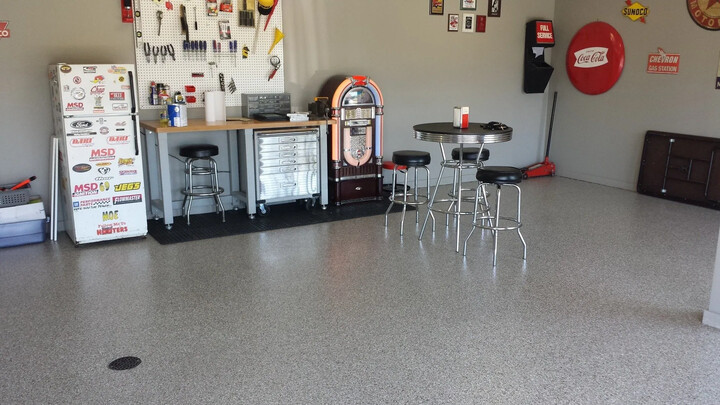 Get Your Garage Done Before the Holidays: Why Fall Is the Best Time to Coat
Lower humidity, fewer storms, and milder heat make fall the best time to coat a Florida garage floor. Here is
Get Your Garage Done Before the Holidays: Why Fall Is the Best Time to Coat
Lower humidity, fewer storms, and milder heat make fall the best time to coat a Florida garage floor. Here is
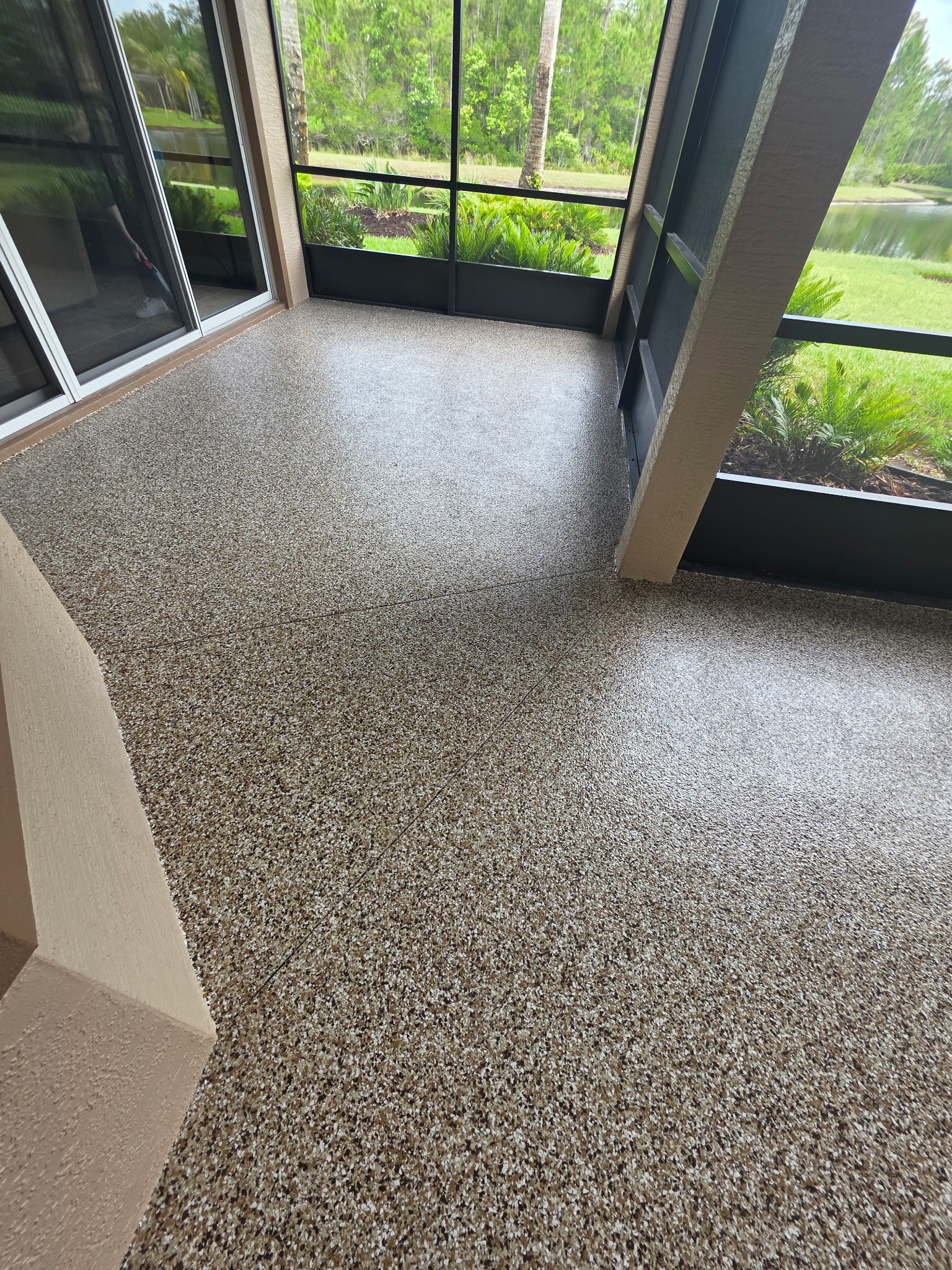 Beyond the Garage: Coating Patios, Basements, and Commercial Floors
The same polyaspartic system that fixes a garage works on patios, lanais, interior slabs, and commercial floor
Beyond the Garage: Coating Patios, Basements, and Commercial Floors
The same polyaspartic system that fixes a garage works on patios, lanais, interior slabs, and commercial floor
Explore more
See the finishes we offer, read what your neighbors say, or find another community we serve near Storm Ready Floors: How Concrete Coatings Handle Florida's Humidity and Flooding.
Flake & metallic styles
Browse our flake and metallic finishes.
View styles →Reviews
Real results from homeowners and businesses across Central Florida.
Read reviews →Our work
Finished garage, home, and commercial floors from recent jobs.
View gallery →