Beyond the Garage: Coating Patios, Basements, and Commercial Floors
Most people find us because of a garage. The tires are leaving black marks, the slab is stained, and the space looks nothing like the rest of the house. That is a fair reason to call. But the same coating that fixes a garage floor works on a lot of other concrete, and once homeowners see the finished garage they usually ask what else we can do.
The short answer is: almost anywhere you have a concrete slab. Covered patios and lanais, interior slabs like laundry rooms and sunrooms, workshops, home gyms, and the showrooms, shops, and warehouses that keep local businesses running. This post walks through each one and, more importantly, what changes about the job when you move out of the garage. Because the product may be the same, but the conditions are not.
Why the coating that works in a garage works elsewhere
A garage is one of the harder environments for a floor coating. It takes hot tires, dropped tools, oil, road salt tracked in from a beach trip, and in Florida it takes humidity and the occasional flood. A system that holds up in a garage is not going to be troubled by a patio or a laundry room.
We install polyaspartic systems in flake, metallic, and solid finishes. The reason that matters outside the garage comes down to three properties. Polyaspartic is UV stable, so it does not yellow in sunlight the way standard epoxy does. It cures fast, so most floors are back in service in about a day. And it is flexible enough to handle the daily expansion and contraction that a Florida slab goes through between a cool morning and a 95 degree afternoon.
What stays the same on every job, garage or not, is the prep. We diamond grind the slab with vacuum-assisted equipment, repair cracks and spalls, and check for moisture before anything goes down. Coatings do not fail because of the room they are in. They fail because of what was skipped underneath them.
Covered patios and lanais
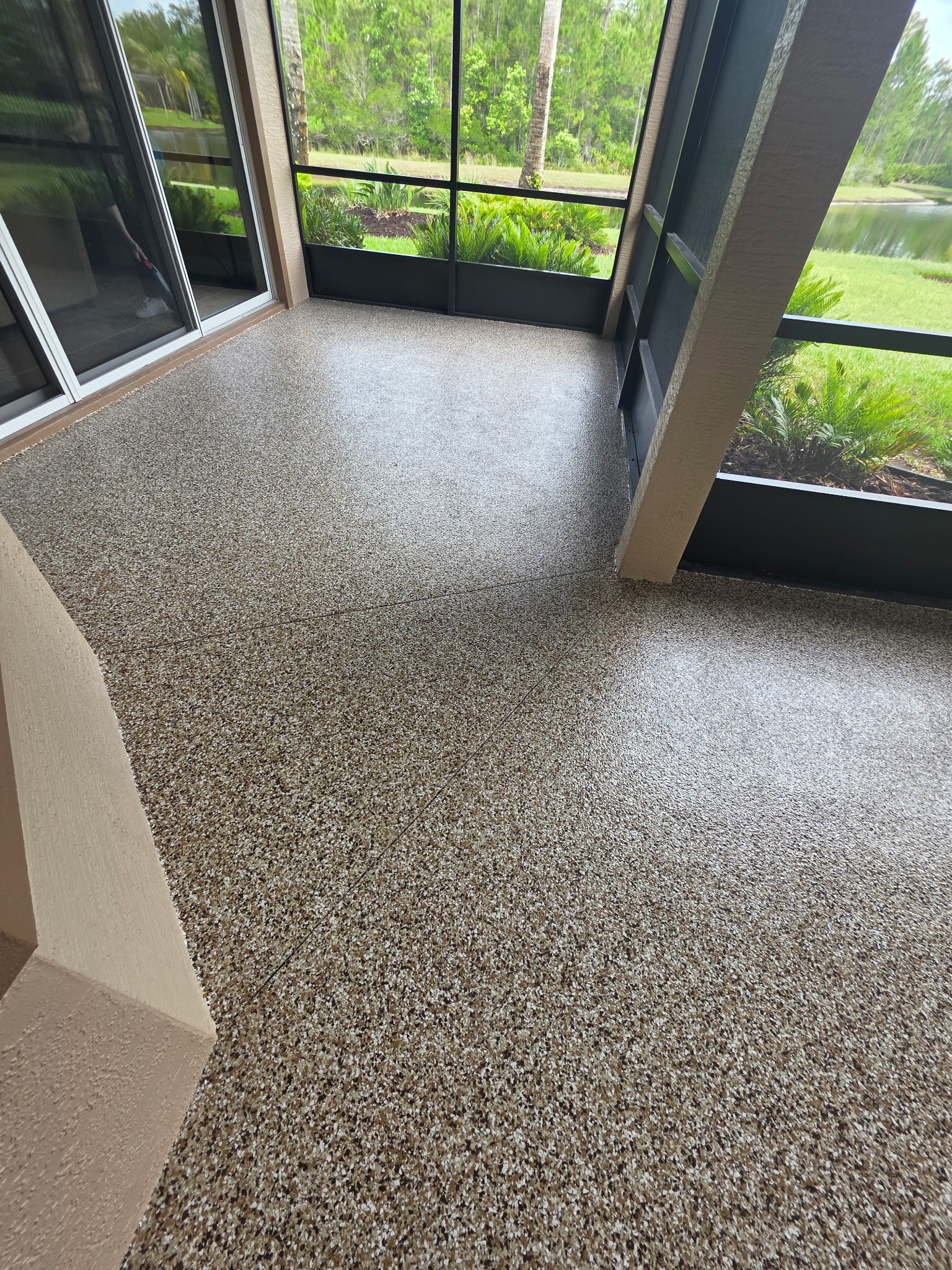
This is the most common request after the garage, and in Central Florida it makes a lot of sense. A lanai is an outdoor living room. It is where the grill is, where the dog sleeps, where the pool water gets tracked. Bare concrete out there stains, grows mildew in the grout of the texture, and looks tired within a couple of years.
A coated lanai floor is sealed, so pollen, tannin stains from leaves, and rust from patio furniture wipe off instead of soaking in. Pressure washing becomes a quick rinse.
Three things change when we take the system outdoors.
Sun exposure. This is where UV stability stops being a nice-to-have. An epoxy floor on a west-facing lanai will amber and chalk. Polyaspartic will not. If you have been quoted an epoxy system for an outdoor space, that is a question worth asking the installer directly.
Traction. A smooth, glossy floor and a wet pool deck are a bad combination. On lanais, pool surrounds, and covered entries we add a non-slip aggregate to the topcoat, or step down to a satin finish, so the floor has grip when it is wet. The flake finish already has some texture built in; the additive takes it further. We will talk through the right level for how the space gets used.
Heat underfoot. Dark floors in direct sun get hot. For an uncovered section of patio we steer toward lighter flake blends, which stay noticeably cooler on bare feet. Under a screen enclosure or a roof it matters less.
We also pay close attention to where the coating meets the pool coping, door thresholds, and any drains, since those edges take the most water and the most foot traffic.
Basements and other interior slabs
Yes, we get asked about basements, and yes, a few exist along our stretch of coast. Most Florida homes do not have one because of the water table, but the request usually means the same thing: an interior concrete floor that is bare, cold looking, and not finished like the rest of the house. That covers laundry rooms, utility rooms, sunrooms, enclosed Florida rooms, bonus rooms over a slab, home gyms, and hobby spaces.
For the handful of true below-grade basements we do see, moisture is the entire conversation. Below-grade concrete in Florida is under constant pressure from groundwater, and moisture vapor moving up through the slab is the number one killer of coatings. We test before we quote, and we will tell you plainly if a slab needs a moisture-mitigating primer or if the numbers are high enough that a coating is not the right call. We would rather lose a job than install a floor that lifts in six months.
For the more common interior slab, the job is closer to a garage than most people expect, with a few differences.
Dust control matters more. Grinding indoors, next to finished living space, means the vacuum-assisted grinding setup is doing real work. We seal off doorways and keep the dust where it belongs.
Odor and cure time. Polyaspartic has a short cure window and low odor compared to older solvent-based systems, which is exactly what you want in a laundry room that is ten feet from the kitchen. Most interior floors can take foot traffic the next day.
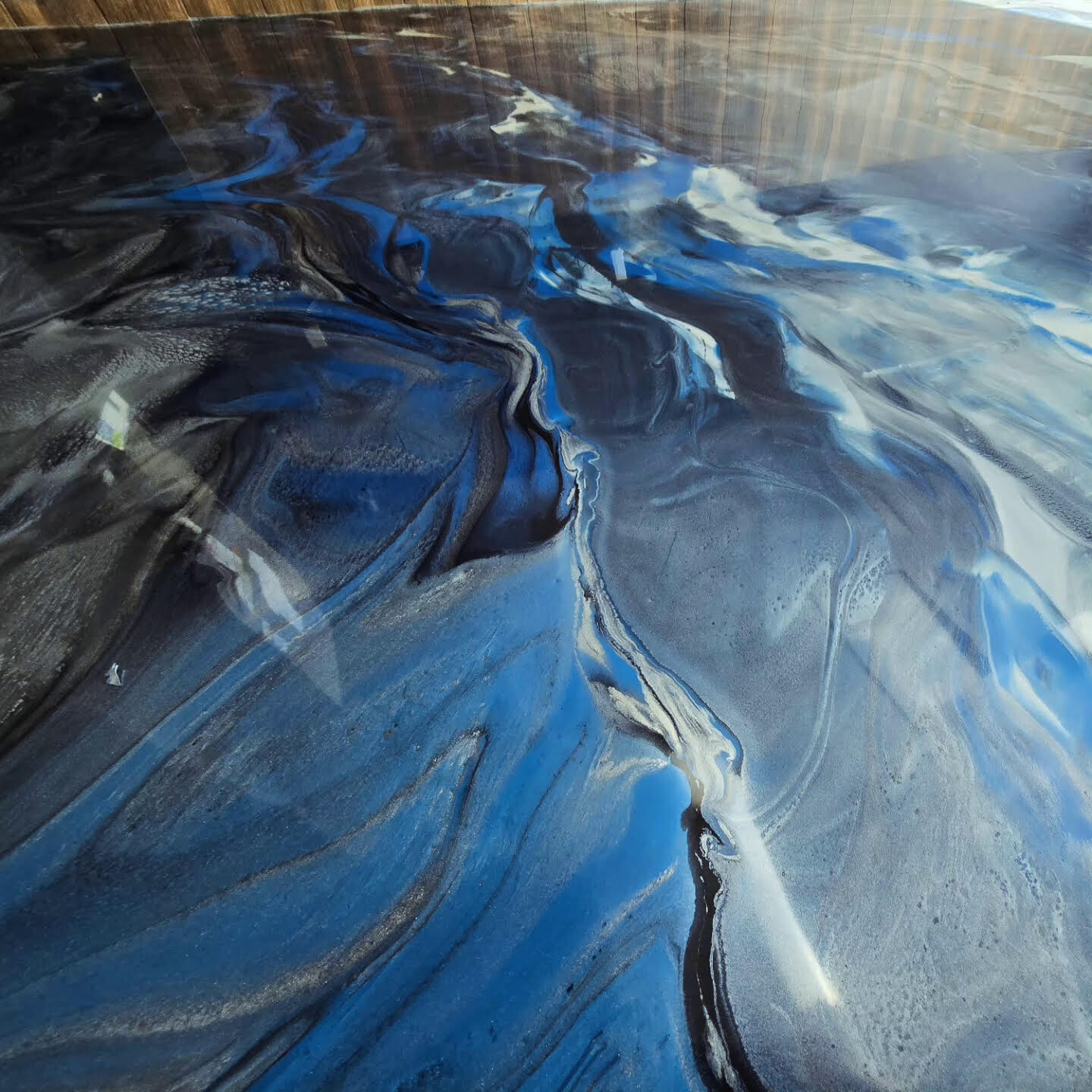
Finish choice. Interior spaces are where the metallic finish really earns its keep. A metallic floor in a sunroom or a home gym reads as a designed surface, not a utility floor. Flake in a neutral blend is the workhorse choice for laundry and utility rooms, where it hides lint and grit between cleanings. You can see both on our styles page.
Slip resistance comes up here too. An entryway or a laundry room gets wet. We can add texture to the topcoat in the same way we do outdoors.
Workshops, home gyms, and sheds
These sit somewhere between a garage and a living space. A workshop takes dropped tools, sawdust, and solvent spills. A home gym takes dropped weights and sweat. A coated floor handles all of it, cleans with a mop, and is far easier on the knees and on equipment than bare concrete.
One practical note for gyms: if you are dropping heavy plates, put a rubber mat under the rack. The coating is tough, but no floor coating is designed to absorb a 45 pound plate from shoulder height, and the concrete under it can crack regardless of what is on top.
Commercial and industrial floors
This is the part of our work that most homeowners never see, and it is where the fast cure of polyaspartic matters most. We coat floors for shops, showrooms, retail spaces, restaurants and bars, warehouses, distribution space, auto shops, and hangars across Volusia, Flagler, and the Orlando area. You can read more on our commercial and industrial flooring page.
For a business, the floor itself is only half the decision. The other half is downtime. Every hour the doors are closed or a bay is out of service costs money, and older epoxy systems could take days to walk on and a week to put equipment back on. With polyaspartic, most commercial floors are back in service in about a day, and we work around your schedule, including evenings and weekends where needed, so the install lands in the quietest window you have.
What we think about differently on a commercial job:
Traffic and load. Forklifts, pallet jacks, rolling toolboxes, and constant foot traffic wear a floor in a way a two-car garage never will. The system is built up accordingly, and the prep is, if anything, more aggressive.
Chemical exposure. Auto shops, restaurant kitchens, and warehouses see oils, solvents, degreasers, and cleaning chemicals every day. Polyaspartic resists the ones that stain and soften bare or painted concrete, which turns a scrubbing job into a squeegee job.
Slip resistance and safety. Wet areas, entries, and loading zones get a non-slip additive, and we can vary the texture by zone so a showroom floor stays clean-looking while the service bay has grip.
Appearance. A showroom or restaurant floor is part of the customer's first impression. Solid colors, metallics, and custom flake blends let a business floor match the brand instead of looking like a warehouse. We can also lay out safety lines and zone markings in the coating itself.
One thing to be aware of: our lifetime warranty applies to residential floors, for as long as you own and live in the home, with certain limitations. Commercial floors are quoted with their own terms based on the use of the space, and we walk through that with you before you sign anything.
What does not change
Whether it is a lanai in Ormond Beach, a laundry room in Port Orange, or a warehouse bay in Daytona Beach, the same things decide whether the floor is still perfect in ten years.
The slab is mechanically profiled, not acid etched or just cleaned. Cracks and spalls are repaired, not coated over. Moisture is tested, not assumed. The system is a real multi-coat build, with a topcoat. And it is installed in the right conditions, by people who will still be here to stand behind it.
You work directly with Ryan from the first look to the final walkthrough, and that is true on a 200 square foot patio and a 20,000 square foot warehouse.
Thinking about a floor outside the garage?
If you have a patio, lanai, interior slab, or a business floor that is bare, stained, or wearing out, reach out for a free quote or call (386) 679-0226. We will look at the space, test the slab, and tell you exactly what we would do and why. If a coating is not the right answer for that surface, we will tell you that too.
Frequently asked questions
Can you coat a patio or lanai that is exposed to direct sun?
Will a coated pool deck or lanai be slippery when wet?
Do you coat basements in Florida?
How long will my business be shut down for a floor coating?
Is the lifetime warranty the same for commercial floors?
Can you match the coating to my patio furniture or my business branding?
Do I need to do anything to prepare the space?
Get a real number for your garage
Free, in person, and firm. We do not price a floor without seeing the slab.
Keep reading
 Storm Ready Floors: How Concrete Coatings Handle Florida's Humidity and Flooding
Florida humidity and storm flooding are hard on a bare garage slab. Here is how a properly prepped coating han
Storm Ready Floors: How Concrete Coatings Handle Florida's Humidity and Flooding
Florida humidity and storm flooding are hard on a bare garage slab. Here is how a properly prepped coating han
 How Much Does a Garage Floor Coating Cost in Daytona Beach?
What drives garage floor coating pricing in Volusia and Flagler County, what a low quote usually leaves out, a
How Much Does a Garage Floor Coating Cost in Daytona Beach?
What drives garage floor coating pricing in Volusia and Flagler County, what a low quote usually leaves out, a
 Polyaspartic vs Epoxy Garage Floors in Florida: Which One Actually Lasts?
Florida heat, UV, and humidity are hard on garage floor coatings. Here is how polyaspartic and epoxy actually
Polyaspartic vs Epoxy Garage Floors in Florida: Which One Actually Lasts?
Florida heat, UV, and humidity are hard on garage floor coatings. Here is how polyaspartic and epoxy actually
Explore more
See the finishes we offer, read what your neighbors say, or find another community we serve near Beyond the Garage: Coating Patios, Basements, and Commercial Floors.
Flake & metallic styles
Browse our flake and metallic finishes.
View styles →Reviews
Real results from homeowners and businesses across Central Florida.
Read reviews →Our work
Finished garage, home, and commercial floors from recent jobs.
View gallery →